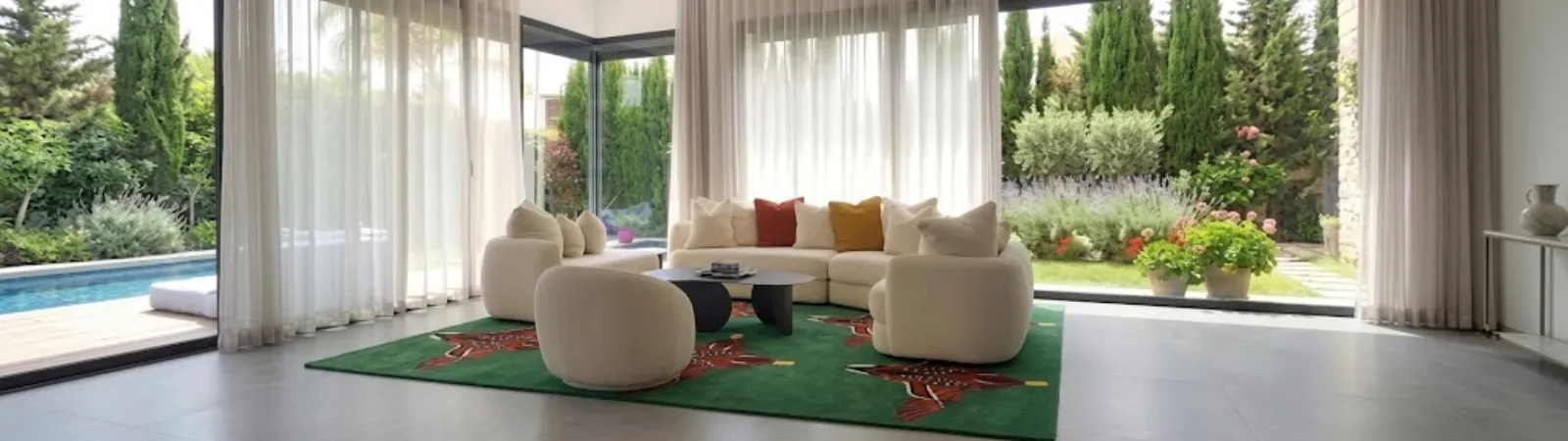
Animal Print Carpet Ideas for Living Rooms, Bedrooms & More
There’s a certain kind of room that photographs well but somehow forgets to feel like anyone lives there. Animal print
Something has changed the way people think about their floors. For years, the rug decision was simple: pick a size, pick a color, make sure it doesn’t clash. The shape was never really part of the conversation because it was always a rectangle.
That’s no longer the case. Irregular-shaped area rugs have moved into the mainstream, and the reasons go beyond aesthetics. Designers are specifying them. Homeowners are seeking them out, and rooms without these rugs tend to look noticeably less considered.
This isn’t a short-lived trend. It connects to a broader shift in how modern interiors are being designed. Understanding that shift explains why these rugs work as well as they do.
The conversation about interior design has changed significantly over the last few years. The clean, grid-heavy aesthetic defined many contemporary spaces. Sharp lines, symmetrical layouts, everything squared off, all of it has gradually given way to something softer. Curved furniture began appearing in places where boxy pieces had once dominated. Arched doorways came back. Organic textures replaced engineered surfaces in many homes.
The rectangular rug never caught up with that shift. It still follows the same logic it always did: fill the floor, match the furniture, stay out of the way. Which is fine, but it’s also passive. In a room that’s actively trying to feel warmer and more human, a rectangle can end up working against that.
An irregular rug fits the current direction of interiors in a way a rectangle simply doesn’t. The outline does something. It introduces a shape that doesn’t repeat elsewhere in the room, breaks up predictable geometry, and gives the eye a place to land that isn’t another straight edge. For spaces already working with softer furniture and natural materials, that contribution matters more than people expect.
Beyond aesthetics, there’s a practical dimension too. Open-plan living spaces, which most modern homes have in some form, are notoriously difficult to zone without making the floor look like a grid. An irregular or asymmetrical rug defines an area more naturally than a rectangle. It draws the zone without enclosing it in a box. For a closer look at how irregular rugs compare to traditional formats, our guide on irregular rugs vs traditional rugs covers that in detail.
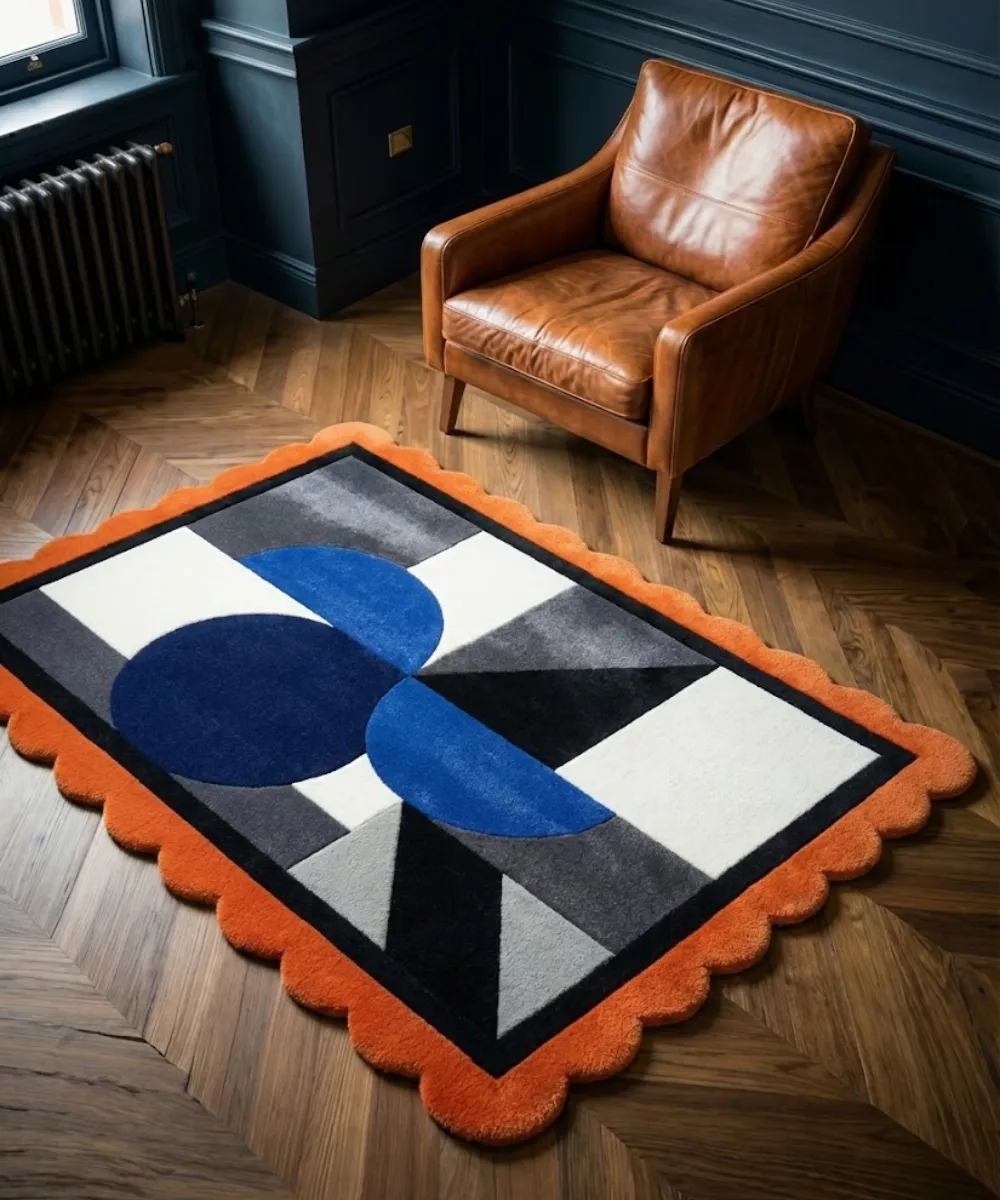
What makes an irregular rug effective isn’t necessarily the pattern or color. It’s the silhouette itself. When the outline of a rug is unexpected, the whole piece reads differently. It stops being background and starts being a decision.
In a room with neutral walls and understated furniture, a shaped rug becomes the focal point without being overly loud. The outline carries the visual interest. The rest of the room can stay calm.
Texture area rugs with irregular shapes take this a step further. When the surface has carved pile, raised detailing, or a mix of cut and loop construction, the rug reflects light differently at different angles and times of day. It changes subtly as the room’s light changes. That kind of depth is something flat-woven rectangular rugs rarely achieve, and it’s one reason shaped rugs tend to feel more alive in a space.
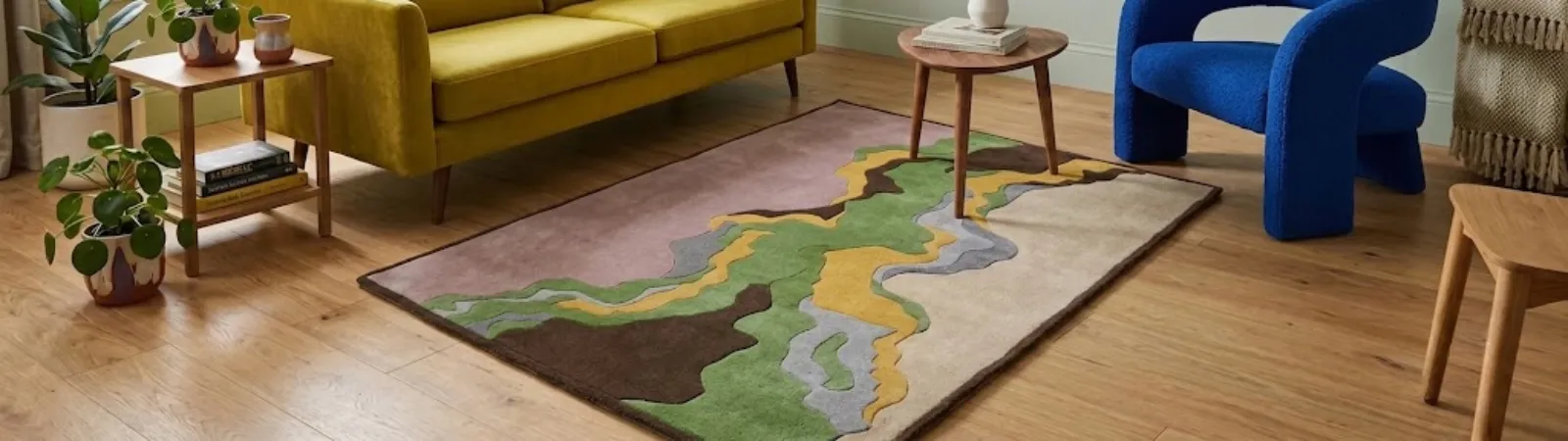
Abstract irregular shape rugs work on a similar principle. The pattern is freeform but not repetitive. It moves across the surface without a predictable structure. The combination of irregular silhouette and abstract design creates something that genuinely functions as art on the floor. Not in a way that overwhelms the room, but in a way that gives it a center.
Break Free from Traditional Rug Shapes
Discover unique-shaped rugs that add creativity and make every room feel more memorable.
The ScallopedRugs irregular collection covers a wide range of shapes, patterns, and colorways, with options that suit different rooms and preferences. Here are some of the most popular pieces worth knowing about:
The shape of a rug is only as strong as its construction. This is where the handmade distinction matters more than it might seem.
A machine-cut irregular rug is shaped by a die or a programmed cutter. The outline is consistent, but it’s also mechanical. There’s a slight stiffness to the edges. Over time, these edges tend to fray or flatten, losing the definition that made the piece interesting in the first place.
A hand-tufted irregular rug is different. The pile is built by hand, loop by loop, and the edge is shaped and finished by a person who’s looking at it as it develops. The result is a rug whose edges hold their form properly — not because they’ve been sealed or stiffened, but because the construction underneath them is dense and deliberate.
There’s also the question of surface depth. Texture area rugs with irregular shapes made by hand can incorporate carved detailing, varied pile heights, and mixed construction techniques that a machine simply can’t replicate at the same quality level. That variation in surface is what keeps the rug responding to light in a way that feels fresh over time rather than flat.
For anyone considering an irregular-shaped rug as a long-term investment in a space, handmade construction isn’t a luxury detail. It’s what makes the piece worth buying. Before committing to a size, our rug sizes chart and guide are worth checking to make sure the proportions work for your specific room, and the odd-shaped rugs buying guide covers what to look for before you decide.
Add Artistic Character to Any Room
Discover distinctive rug designs that bring comfort and creativity to your room.
The rectangular rug had a good run. It still works for what it is. But in rooms that are trying to feel genuinely designed rather than just furnished, it increasingly isn’t enough.
Irregular-shaped area rugs do something rectangles can’t: they contribute to the room’s visual identity rather than just occupying floor space. The shape is a design decision in itself, and in spaces where everything else is considered, that decision tends to make a real difference.
The shift toward organic, freeform, and irregular shapes in modern interiors isn’t slowing down. If anything, as curved furniture and softer palettes continue to define the direction of contemporary design, the shaped rug becomes less of an outlier and more of an obvious next step.
There’s a certain kind of room that photographs well but somehow forgets to feel like anyone lives there. Animal print
Most rooms don’t fall apart because the furniture is wrong. They fall apart because nothing on the floor is doing
Elevate your living space with designer collections.
Get
Off on Your First Order