Why Runner Rugs Are Essential for Hallway Design
The hallway is the first area that welcomes guests and the last thing most homeowners get around to sorting. It collects more daily foot traffic than the living room or a bedroom, and yet it tends to get the least thought of any floor in the house. A good hallway runner rug fixes that without touching a wall or moving a single piece of furniture.
Beyond looks, a runner rug serves a practical purpose. It protects the floor underneath, reduces noise between rooms, and traps dirt at the entrance of your living spaces, helping keep the rest of the house cleaner.
Adding the right runner between the spaces becomes a proper introduction to the rest of the home. First impressions in interior design almost always happen in the hallway, and a runner is one of the lowest-effort ways to make that impression deliberate.
Discover Stylish Hallway Runner Rugs at ScallopedRugs
Most rug collections treat runners as an afterthought, offering a handful of widths and a couple of inoffensive patterns. ScallopedRugs takes a different approach.
Our runner collection covers widths from 2 ft through to 4 ft, with lengths extending up to 18 ft, so unusual hallway dimensions are not a problem. Every piece is hand-tufted using New Zealand wool and viscose. It gives the pile the kind of recovery that synthetic runners cannot replicate after months of daily foot traffic.
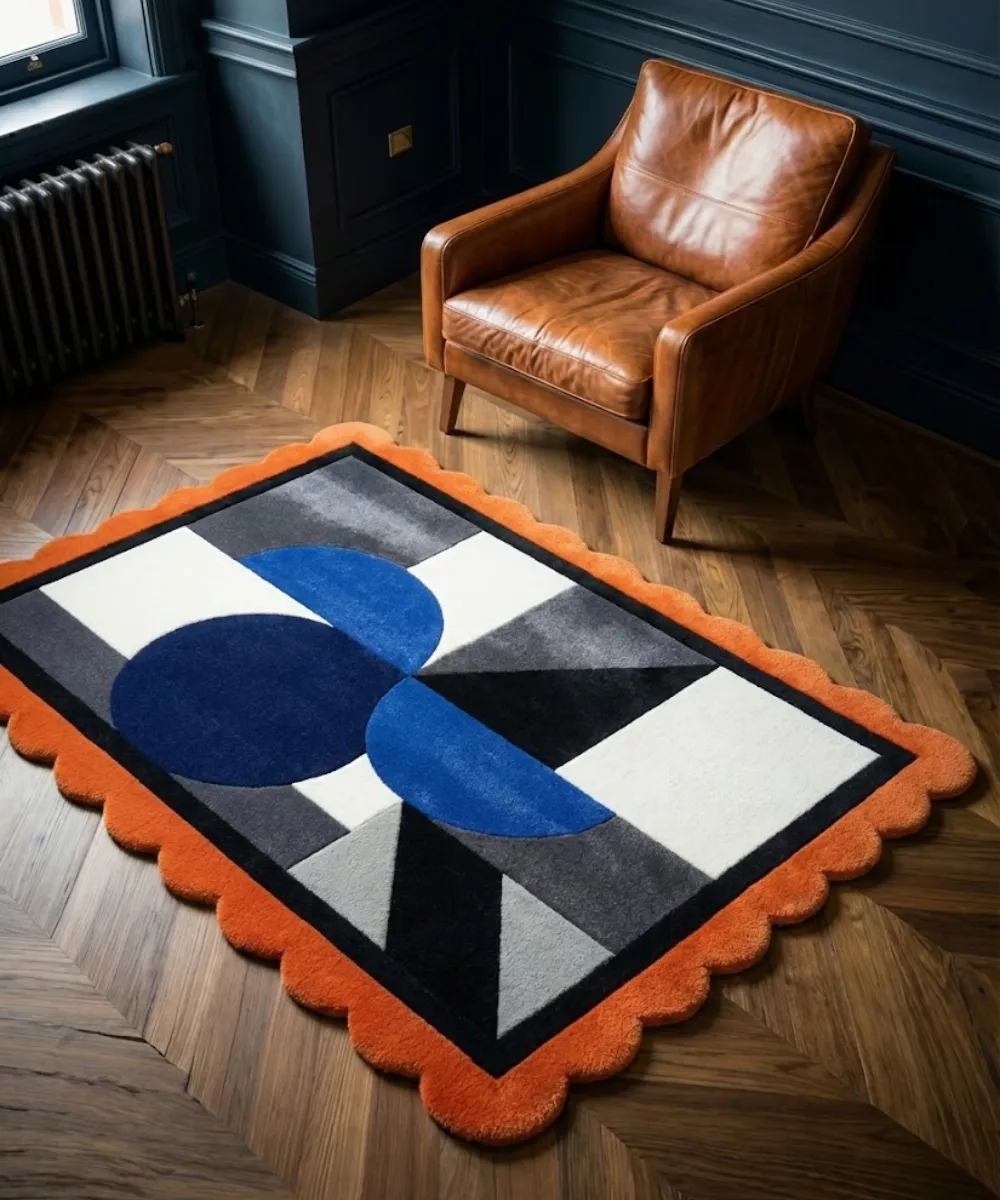
The scalloped edge is the detail that sets these apart. Beyond the straight-cut border, we have runners with curved, wavy, and even organic silhouettes. Styles run from the bold geometric pattern of the Marvion Trace to the dense florals of the Cassia and Meadow Bloom and beyond. Browse the full runner collection to find the right fit for your hallway.
10 Stunning Ways to Style Runner Rugs in Hallways
Styling a runner rug well comes down to a few decisions made in the right order. These ten ideas cover the most common hallway scenarios, from narrow entryways to long corridors, so you can take what applies and skip what does not.
- Size It Longer Than Feels Safe: The most common runner rug mistake? Buying one that’s too short. When a runner stops well before the hallway ends, it draws the eye straight to that gap. As a result, the floor appears unfinished. A good rule of thumb: leave 6 to 12 inches of bare floor at each end, rather than trying to cover the space wall-to-wall. If you’re working with a longer corridor, ScallopedRugs offers runners up to 15 feet long. You can cover the full stretch without joining two pieces together in the middle.
- Layer a Solid Runner Over Patterned Tile: Got a busy hallway floor? A solid-color runner gives the eye a place to land. ScallopedRugs’ Dusty Blue runner is a great fit here. Its calm tone holds its own against coloured tile, while the scalloped edge keeps things from feeling too flat. And because the wool is hand-tufted, the texture itself adds enough visual interest that you don’t really need a pattern.
- Use a Bold Pattern to Pull the Eye Through: A contemporary hallway runner rug with geometric designs draws attention to the far end of the corridor. It makes the space feel longer and more purposeful. The Marvion Trace runner, with its cream grid on a deep burgundy ground, does this particularly well. In a narrow hallway, that lengthening effect is often exactly what the space needs.
- Connect the Runner to Your Staircase: If your hallway leads into a staircase, try picking a runner that echoes the stairs’ color. It keeps the eye moving instead of stopping short. You don’t need an exact match. A modern runner rug in a complementary tone is enough to connect the two spaces.
- Contrast Against the Floor, Not the Walls: Most people try to pick a runner that matches the wall color. The more reliable method is to contrast it against the floor. A dark wool runner rug on a light timber surface, or a pale runner on dark stone, gives the piece the separation. It needs to register as a design choice rather than an oversight. Against a floor in the same tone, even a well-made runner disappears.
- Keep Width Restrained in a Narrow Corridor: A hallway under four feet wide needs a narrower runner. ScallopedRugs’ runners start at 2 feet wide. They are narrow enough to leave the floor showing on each side, which frames the rug properly. Squeeze a wider runner into a tight hallway, and you lose that breathing room. The corridor feels cramped rather than easy to walk through.
- Sort the Non-Slip Situation Before Anything Else: On polished timber, stone, or tile, a runner without grip is going to move. It’s more of a safety issue than a styling one. The solution can be a non-slip runner rug with rubber or latex backing built right in. Another option is a separate underlay cut slightly smaller than the rug, so it stays hidden at the edges. On hard floors, the separate underlay usually wins out. It doesn’t grind against the surface with every step, so it lasts longer than built-in backing does.
- Treat the Hallway With the Same Seriousness as Any Other Room: Most hallways look underdressed for one simple reason: people rush the decision. Treat it the way you’d treat any other room. Does the pile height clear the door as it swings over it? Does the pattern sit well with the wall color? Does the width still leave the floor showing on each side? A floral runner rug like the Cassia or Meadow Bloom deserves that same care, and so does the hallway.
- Match the Runner Style to the Architecture: If your home has original cornicing, paneled doors, or encaustic tile, a floral runner can pick up on that period detail rather than fight it. The Cassia Floral Runner is a good example. Its pink, burgundy, and purple flowers on a cream base sit naturally against Victorian or Edwardian features, without tipping into theme-park territory. In a contemporary home, the Honey Lattice or Jewel Shards geometric runners carry the cleaner, more graphic sensibility that those interiors call for.
- Change the Runner Before You Change the Walls: If the hallway feels wrong but you cannot identify why, swap the runner first. A new runner shifts the entire color reference for the space. Sometimes that one change resolves what felt like a bigger problem. At a minimum, it tells you whether the walls actually need attention or whether the floor was doing all the damage.
CTA
The full ScallopedRugs runner collection, including sizes from 2 ft wide up to 4×15 ft, is available at scallopedrugs.com/product-category/area-rugs/runner-rugs/. Filter by color, size, or pattern to quickly get to the right shortlist.
How to Choose the Perfect Runner Rug for Your Hallway
Four decisions, taken in order, settle nearly every hallway runner question before it becomes a problem.
- Size first. Start by measuring the hallway, then subtract 12 to 24 inches total for the bare border at each end. For width, aim to leave 3 to 4 inches of floor showing on either side. ScallopedRugs covers this well. Our runners come in 2, 2.5, 3, 3.5, and 4 ft widths, with lengths up to 15 ft, so most hallways (standard or oddly sized) will find a fit. To know more about rug sizes, read our guide.
- Material second. The ScallopedRugs collection uses New Zealand wool and viscose throughout. Wool handles compression and recovery better than synthetic fibers, which matters in a hallway where the same strip of floor takes foot traffic every single day. The pile does not flatten permanently the way polypropylene does over time.
- Pile height third. Low-to-medium piles work best in hallways where a door swings over the rug. A high pile catches the door sweep and becomes a daily irritation in no time. Flat-weave or low-pile options are the safest choice anywhere near a threshold.
- Pattern last. Once size, material, and pile height are settled, pick the pattern. A runner that fits correctly and wears well in a design you like will serve the hallway for years. One that looks good in a product photo but catches the door on day one will not make it to year two.
Final Thoughts
A hallway runner is a small decision that changes how the whole space feels. Get the size right, choose wool for durability, sort the non-slip backing, and pick a pattern that suits the room and the architecture around it. Do that, and the hallway finally pulls its weight.
FAQs
What size runner rug is best for a hallway?
Measure the full length of the hallway, then subtract 12 to 24 inches from each end for the bare floor. For width, leave 3 to 4 inches of floor showing on either side. ScallopedRugs runners run from 2 to 4 ft wide, with lengths up to 15 ft. It’s enough to cover most standard and longer corridors. If you’re torn between two lengths, go with the longer one. A runner that stops mid-hallway just looks like a sizing mistake.
Are runner rugs suitable for high-traffic hallways?
Yes, runner rugs made from the right materials are ideal for high-traffic hallways. ScallopedRugs runners are hand-tufted using New Zealand wool and viscose, a blend that bounces back under daily foot traffic instead of flattening permanently. Wool also cleans more easily than many synthetic fibers once dirt gets ground in, making it an excellent choice for busy entryways and corridors.
Does ScallopedRugs offer runner rugs for narrow hallways?
Yes. Our collection starts at 2 ft wide, making it ideal for narrow corridors where wider runners would crowd the skirting boards. Leaving a visible strip of flooring on each side helps the hallway feel more open and balanced.
How do I keep a hallway runner rug from slipping?
You have two options: choose a non-slip runner rug with built-in backing or use a separate rug pad cut slightly smaller than the rug so it remains hidden. On polished timber or stone floors, a quality rug pad often provides better long-term grip. Position the pad about an inch inside the rug’s edges on all sides for the best results.
Can I find custom hallway runner rugs at ScallopedRugs?
Yes. If your hallway falls outside standard dimensions, contact the team through the ScallopedRugs contact page. Whether you need an extra-long runner, a narrow design, or a completely custom size, a rug made specifically for your space will always provide the best fit and appearance.