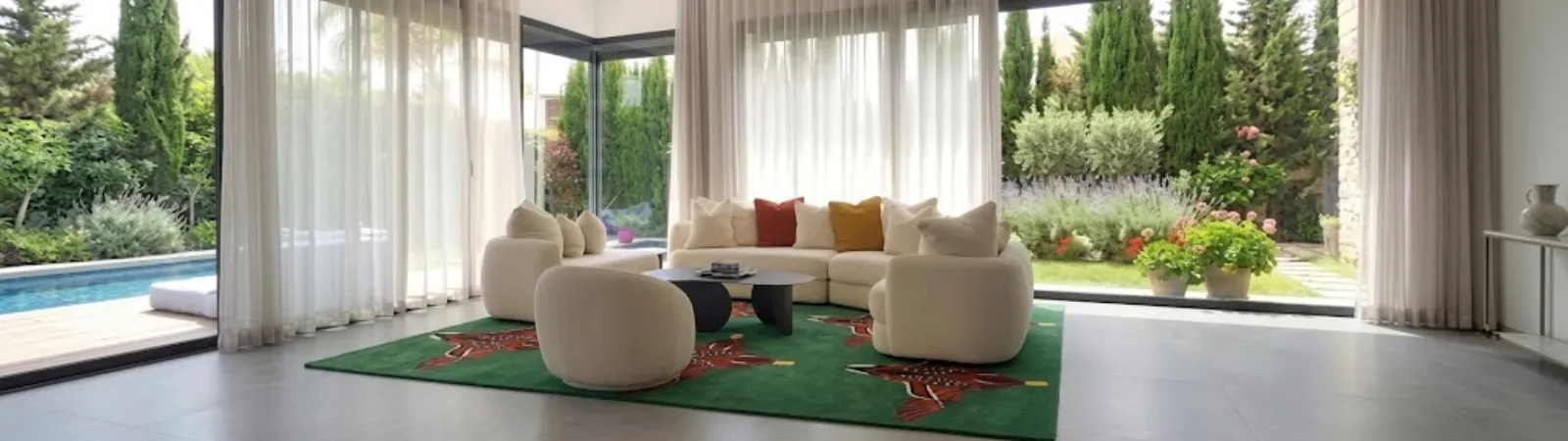
Animal Print Carpet Ideas for Living Rooms, Bedrooms & More
There’s a certain kind of room that photographs well but somehow forgets to feel like anyone lives there. Animal print
Three letters, yet almost no one asks what they stand for. DIY appears on paint cans, on craft kits, and in countless captions beneath photos of redecorated living rooms. It is used so often that its meaning has quietly been lost. Ask someone to define it, and most people pause.
That gap between using a term and understanding it is worth closing, especially since DIY shapes so much of modern interior design, right down to the rug under the coffee table.
This guide breaks down the actual meaning of DIY, why rugs in particular have become one of the most popular DIY projects in home decor right now, and a full set of creative techniques you can try yourself. It also covers when a store-bought designer rug is the better choice and why.
DIY stands for “do it yourself.” The phrase entered common English usage in the 1950s, when homeowners began taking on repairs, small renovations, and craft projects themselves rather than hiring a professional for every job. Over the following decades, the meaning broadened well past repair. Today, it covers anything a person builds, customizes, or fixes independently, using their tools, time, and materials rather than paying someone else to do it.
In home decor, DIY simply means creating, modifying, or customizing items yourself instead of purchasing ready-made products. This could include making a rug, building a shelf, or reupholstering an old chair. What connects every DIY project is the freedom to choose the materials, size, color, and final look without paying for professional services.
Rugs sit at an interesting intersection of this history. They’re functional, highly visible in almost every photo of a finished room, and among the easiest textiles to modify without specialized equipment. That’s why they’re a popular DIY project and a practical way to understand what DIY really means.
A few things are driving the current wave of interest in DIY rug projects, and none of them are especially new. What’s changed is how visible the results have become.
None of these reasons—the personal touch, the low cost, the shareability, and the upcycling—mean every rug in a room should be homemade. But together they explain why DIY rug-making has stuck around: it’s a genuinely satisfying way to personalize a space, as long as you’re realistic about what a handmade rug can deliver and when a professionally made one is the better call.
These are the techniques that show up most often in real DIY projects, ranked roughly from easiest to most involved.
Each of these can be scaled up or down depending on the space. A small stenciled mat by the front door takes an afternoon. A full living room rug made from braided rag strips is a multi-weekend project, and it’s worth being honest about that time commitment before starting.
Where you place a rug determines which DIY technique makes the most sense and how much wear it needs to withstand.
DIY has real limits. A homemade rug can be personal, low-cost, and satisfying to make, but it won’t match the density, structure, or lifespan of a properly hand-tufted or hand-knotted piece. Uneven tension in a braided rug, fabric paint that cracks over time, or a rope coil that loosens with foot traffic are common problems that a well-constructed rug avoids entirely.
That’s where ScallopedRugs fills the gap that a DIY project can’t. Every rug in the collection is handcrafted using techniques that hold both shape and color over years, not months, whether it’s a bold organic silhouette or a quiet solid tone. For anyone comparing a weekend project against one of the best area rugs available online, the difference usually comes down to how the piece looks and performs a year or two later, not on day one.
The range also spans the same styles people typically try to replicate at home: painterly abstract patterns, solid neutral tones, striking irregular shapes, and everything in between. Rather than searching for Home Depot runner rugs or piecing together a DIY hallway mat, you can find a durable, ready-made runner sized and styled for the exact room it’s going into. You can browse the full range any time on ScallopedRugs.com.
Understanding the real DIY meaning behind a project, not just the acronym, makes it easier to decide which rug projects are actually worth attempting and which ones are better left to a professional maker. A stenciled entryway mat or a braided accent rug is a genuinely rewarding weekend project. A large, heavily trafficked living room rug is a bigger commitment than most people expect.
There’s no wrong answer between making a rug yourself and buying one. The call depends on the room, the traffic it gets, and how much time you actually want to spend on the project, especially once you start comparing the results to the best ready-made area rugs. Either way, understanding what DIY means in practice and having the patience, control, and willingness to learn make the whole process far less intimidating than it looks in a five-minute video.
If you’d rather skip the glue and stencils this time around, ScallopedRugs has a rug-and-home pairing ready for nearly every room and style, from hand-tufted solids to bold irregular shapes. Explore the collection and see what fits your space.
It depends on the technique. Stenciled and painted rugs need a plain rug or canvas drop cloth, painter’s tape, and fabric paint. Braided and woven rugs need fabric strips or T-shirt yarn, scissors, and a needle and thread. Pom pom rugs need yarn, a fabric or mesh base, and either glue or a needle and thread to attach the pom poms.
Yes, that’s one of the main advantages of making a rug yourself. Color, pattern, size, and shape are all fully adjustable, allowing you to match a DIY rug to almost any room style, from a minimalist bedroom to a colorful kids’ playroom.
Yes. The collection includes a wide range of organic and irregular shapes alongside more traditional rectangular and round options, so there’s a design suited to nearly any interior style, whether it’s bold and sculptural or calm and understated.
Start with a low-traffic space like a bedroom nook or a small entryway mat, since these are more forgiving of an imperfect first attempt. From there, choose a technique that matches your available time. Stenciling and painting take an afternoon, while braided or woven rugs can take several weekends, depending on the size.
DIY rugs are a fun, creative project, but achieving a professional finish takes time, skill, and the right materials. A designer rug delivers superior craftsmanship, durability, and a refined look that’s ready to enjoy from the moment it arrives.
There’s a certain kind of room that photographs well but somehow forgets to feel like anyone lives there. Animal print
Most rooms don’t fall apart because the furniture is wrong. They fall apart because nothing on the floor is doing
Elevate your living space with designer collections.
Get
Off on Your First Order